
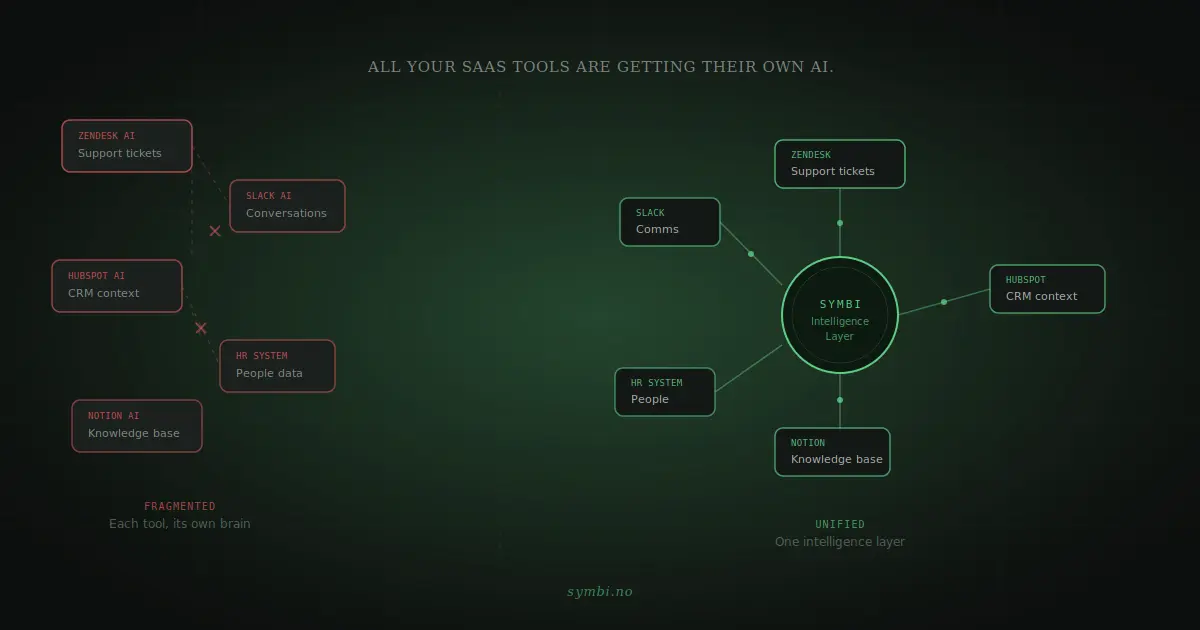
All your SaaS tools are getting their own AI. That's a problem.
A coordination problem nobody warned you about — and what a central intelligence layer actually looks like in practice.
Every software vendor has the same slide in their deck right now.
"Powered by AI."
Zendesk has it. HubSpot has it. Your HR system probably has it. Your project management tool is about to get it. And honestly? A lot of these features are genuinely useful — they save time, they reduce friction, they make individual tools smarter.
But if you're a Head of Ops or IT lead at a company running eight or ten different SaaS tools, you're about to hit a wall nobody warned you about.
The coordination problem
Let me give you a concrete example.
Maria, a customer at one of your enterprise accounts, sends a frustrated email on Monday morning. It's the third time she's written about an incorrect invoice. She mentions she has an audit coming up. The tone is urgent.
Your Zendesk AI picks this up, classifies it as a billing issue, and drafts a response. Reasonable enough. But the Zendesk AI doesn't know that Maria's account manager sent her a message last week promising a manual review was already in progress. That context lives in HubSpot. The Zendesk AI doesn't have access to HubSpot.
So the draft response it generates is technically correct, but misses the point entirely. A support agent approves it without knowing about the promise — because that information was never surfaced. Maria gets a generic reply. She escalates. The account manager is blindsided.
Nobody made a mistake. The tools were all working exactly as designed. But the intelligence was fragmented, and the customer experience suffered for it.
This is not a hypothetical. It is happening in companies right now, and it will get worse as more AI features get switched on across more tools.
Three problems that compound over time
The vendors building these features aren't doing anything wrong. They're solving for their product's context, which is exactly what they should be doing. A Zendesk AI that's great at handling support tickets is genuinely useful.
But it has a ceiling — and that ceiling creates three problems.
Isolated knowledge. Every tool builds its own understanding of your customers, your processes, your products — independently of every other tool. The insights don't travel. When your support team learns something important about how customers misunderstand your pricing, that knowledge lives in your helpdesk. Your sales team never sees it.
Unmanaged decisions. When you turn on AI inside a SaaS tool, you're delegating decision-making to that vendor's model — with their defaults and their guardrails. You get limited visibility into what it's actually doing, and limited ability to change it when it does something you don't like. In regulated markets, this is increasingly a compliance problem, not just an operational one. The EU AI Act requires companies to document, monitor and explain AI decisions. When your AI is distributed across eight tools, each with their own logging and audit trails, that's an extremely difficult requirement to meet.
Lock-in that creeps up on you. You've spent 18 months training Zendesk's AI on your tone, your escalation rules, your edge cases — through every ticket approved, every draft corrected, every custom rule added. Then leadership decides to switch to Intercom. All of that is gone. You start from zero, again, in a new system, with a new vendor's AI that knows nothing about you.
What the market actually needs
What all three of these problems have in common is that they're structural. They're not bugs in any individual tool — they're the predictable result of AI being built inside silos, without any coordination layer above them.
What the market needs isn't smarter AI inside each tool. It's a central intelligence layer that connects them.
That's what we built Symbi to be.
Think HR system, not chatbot
Most AI products in this space are described as assistants or chatbots — something you talk to. Symbi is different, and the framing we keep coming back to is this: think of it less like a chatbot, and more like an HR system for your AI employees.
We deliberately call them digital employees — not agents, not bots, not assistants. Because the mental model matters. When you hire a person, you define their role, give them access to what they need to know, set boundaries around what they're authorised to do, and monitor how they're performing. You don't just turn them loose and hope for the best.
Digital employees work the same way in Symbi. You define what they know, what they're allowed to do, and when they should escalate. They have access to a shared knowledge base that spans your whole organisation — not just what lives inside one tool. And every action they take is logged, traceable, and auditable from one place.
In practice: a customer emails a billing question. The digital employee pulls context from your CRM, checks your knowledge base for the relevant policy, drafts a response, and sends it to your team for review — before anything goes out. Your support rep approves it in 30 seconds. Maria gets a reply that actually addresses her situation. The agent did the legwork. Your team made the call.
Vendor-neutral by design
Because Symbi sits above your tools rather than inside them, your digital employees aren't tied to any single vendor. The knowledge base, the learned behaviour, the workflows you've built — they belong to you, not to Zendesk or HubSpot.
If you switch helpdesks, your digital employees come with you. If you add a new tool, you connect it to Symbi and your agents can work across it immediately.
This also means you stop paying for AI add-ons inside every tool separately, and start investing in intelligence that compounds — knowledge that grows with every interaction, across your entire operation.
Where this is going
Today, Symbi helps you run one or two digital employees well — getting the context right, keeping humans in the loop, giving you visibility across your AI operation.
But the real value compounds over time. Digital employees that share what they learn. A knowledge base that gets smarter with every ticket resolved, every policy updated, every edge case handled. Eventually, digital employees that coordinate with each other — the support agent flagging something to the account management agent, automatically, because they share the same operational picture.
We're not there yet. But the architecture is built for it.
Symbi is a Norwegian company building digital employees for mid-market businesses with complex, multi-tool operations. If the fragmentation problem resonates, book a 30-minute walkthrough — we'll show you what it looks like with your actual stack.
Alle programvareleverandører har den samme sliden i presentasjonen sin akkurat nå.
"Drevet av AI."
Zendesk har det. HubSpot har det. HR-systemet ditt har det sannsynligvis. Prosjektverktøyet ditt er i ferd med å få det. Og ærlig talt? Mange av disse funksjonene er genuint nyttige — de sparer tid, reduserer friksjon og gjør individuelle verktøy smartere.
Men hvis du er driftssjef eller IT-ansvarlig i en bedrift som kjører åtte eller ti ulike SaaS-verktøy, er du i ferd med å møte en vegg ingen advarte deg om.
Koordineringsproblemet
La meg gi deg et konkret eksempel.
Maria, en kunde hos en av dine enterprise-kunder, sender en frustrert e-post mandag morgen. Det er tredje gang hun skriver om en feil faktura. Hun nevner at hun har en revisjon på gang. Tonen er presserende.
Zendesk-AI-en plukker dette opp, klassifiserer det som et faktureringsproblem og utarbeider et svar. Rimelig nok. Men Zendesk-AI-en vet ikke at Marias kundeansvarlige sendte henne en melding forrige uke og lovet at en manuell gjennomgang allerede var i gang. Den konteksten ligger i HubSpot. Zendesk-AI-en har ikke tilgang til HubSpot.
Så svaret den genererer er teknisk korrekt, men bommer fullstendig. En support-agent godkjenner det uten å vite om løftet — fordi den informasjonen aldri ble fremhevet. Maria får et generisk svar. Hun eskalerer. Kundeansvarlig er uforberedt.
Ingen gjorde en feil. Verktøyene fungerte nøyaktig slik de er designet. Men intelligensen var fragmentert, og kundeopplevelsen led for det.
Dette er ikke hypotetisk. Det skjer i bedrifter akkurat nå, og det vil bli verre jo flere AI-funksjoner som skrus på på tvers av flere verktøy.
Tre problemer som forsterker hverandre
Leverandørene som bygger disse funksjonene gjør ikke noe galt. De løser for sitt produkts kontekst, noe som er nøyaktig det de bør gjøre. En Zendesk-AI som er god på å håndtere support-henvendelser er genuint nyttig.
Men den har et tak — og det taket skaper tre problemer.
Isolert kunnskap. Hvert verktøy bygger sin egen forståelse av kundene dine, prosessene dine, produktene dine — uavhengig av alle andre verktøy. Innsikten reiser ikke. Når support-teamet ditt lærer noe viktig om hvordan kunder misforstår prisingen din, lever den kunnskapen i helpdesk-systemet. Salgsteamet ser det aldri.
Ustyrte beslutninger. Når du skrur på AI i et SaaS-verktøy, delegerer du beslutningstaking til den leverandørens modell — med deres standardinnstillinger og deres begrensninger. Du får begrenset innsyn i hva den faktisk gjør, og begrenset mulighet til å endre det når den gjør noe du ikke liker. I regulerte markeder er dette i økende grad et compliance-problem, ikke bare et operasjonelt et. EU AI Act krever at bedrifter dokumenterer, overvåker og kan forklare AI-beslutninger. Når AI-en din er fordelt på åtte verktøy, hvert med sin egen logging og sine egne revisjonslogger, er det et ekstremt krevende krav å møte.
Innlåsing som sniker seg innpå deg. Du har brukt 18 måneder på å trene Zendesk-AI-en på tonen din, eskaleringsreglene dine, kanttilfellene dine — gjennom hver godkjente henvendelse, hvert korrigerte utkast, hver egendefinerte regel. Så bestemmer ledelsen seg for å bytte til Intercom. Alt det er borte. Du starter på null igjen, i et nytt system, med en ny leverandørs AI som ikke vet noe om deg.
Hva markedet faktisk trenger
Det alle tre problemene har til felles er at de er strukturelle. De er ikke feil i noen enkelt verktøy — de er det forutsigbare resultatet av AI som bygges inne i siloer, uten noe koordineringslag over dem.
Det markedet trenger er ikke smartere AI inne i hvert verktøy. Det er et sentralt intelligens-lag som kobler dem sammen.
Det er det vi bygget Symbi for å være.
Tenk HR-system, ikke chatbot
De fleste AI-produkter i dette rommet beskrives som assistenter eller chatboter — noe du snakker med. Symbi er annerledes, og innrammingen vi stadig kommer tilbake til er denne: tenk på det mindre som en chatbot, og mer som et HR-system for AI-ansatte.
Vi kaller dem bevisst digitale ansatte — ikke agenter, ikke botter, ikke assistenter. Fordi den mentale modellen betyr noe. Når du ansetter en person, definerer du rollen deres, gir dem tilgang til det de trenger å vite, setter grenser for hva de har myndighet til å gjøre, og overvåker hvordan de presterer. Du slipper dem ikke bare løs og håper på det beste.
Digitale ansatte fungerer på samme måte i Symbi. Du definerer hva de vet, hva de har lov til å gjøre, og når de skal eskalere. De har tilgang til en felles kunnskapsbase som spenner over hele organisasjonen din — ikke bare det som lever inne i ett verktøy. Og hver handling de tar er logget, sporbar og revisjonsbar fra ett sted.
I praksis: en kunde sender en e-post med et faktureringsspørsmål. Den digitale ansatte henter kontekst fra CRM-systemet ditt, sjekker kunnskapsbasen for relevant policy, utarbeider et svar og sender det til teamet ditt for gjennomgang — før noe går ut. Support-medarbeideren din godkjenner det på 30 sekunder. Maria får et svar som faktisk adresserer situasjonen hennes. Den digitale ansatte gjorde forarbeidet. Teamet ditt tok beslutningen.
Leverandørnøytral by design
Fordi Symbi sitter over verktøyene dine heller enn inne i dem, er de digitale ansatte dine ikke bundet til noen enkelt leverandør. Kunnskapsbasen, den lærte atferden, arbeidsflytene du har bygget — de tilhører deg, ikke Zendesk eller HubSpot.
Hvis du bytter helpdesk, følger de digitale ansatte dine med. Hvis du legger til et nytt verktøy, kobler du det til Symbi og agentene dine kan jobbe på tvers av det umiddelbart.
Det betyr også at du slutter å betale for AI-tillegg inne i hvert verktøy separat, og begynner å investere i intelligens som bygger seg opp — kunnskap som vokser med hver interaksjon, på tvers av hele driften din.
Dit vi er på vei
I dag hjelper Symbi deg med å kjøre én eller to digitale ansatte godt — få konteksten riktig, holde mennesker i beslutningsløkken, gi deg oversikt over AI-operasjonen din.
Men den reelle verdien bygger seg opp over tid. Digitale ansatte som deler det de lærer. En kunnskapsbase som blir smartere med hver løste henvendelse, hver oppdaterte policy, hvert håndtert kanttilfelle. Til slutt, digitale ansatte som koordinerer med hverandre — support-agenten som varsler kundeansvarlig-agenten automatisk, fordi de deler det samme operative bildet.
Vi er ikke der ennå. Men arkitekturen er bygget for det.
Symbi er et norsk selskap som bygger digitale ansatte for mellomstore bedrifter med komplekse, flerverktøys-operasjoner. Hvis fragmenteringsproblemet resonnerer, book en 30-minutters gjennomgang — vi viser deg hvordan det ser ut med din faktiske stack.